Nike Wins Emmy for “Dream Crazy” Campaign starring Colin Kaepernick

H/O: Colin Kaepernick Nike Ad screengrab

Article Credit/Photo Credit: https://www.cnbc.com/2019/09/16/nike-wins-emmy-for-ad-featuring-colin-kaepernick.html

In September of last year, Nike released an advert titled “Dream Crazy.” The ad featured famous athletes like the former NFL quarterback, Colin Kaepernick. His catch phrase in the clip, “Believe in something. Even if it means sacrificing everything. Just Do It.” was obviously in reference to his own protesting the national anthem by taking a knee which eventually resulted in him leaving the San Francisco 49ers in 2017.

This campaign was ultimately deemed a success. However, it didn’t get by without its fair share of backlash. Donald Trump, among other ridiculed Nike for spreading such a “terrible message” that “shouldn’t be sent.” Videos on Twitter and Instagram showed people burning their Nike products and swearing to never give them their business again.

However, these critics can say what they want because the ad won an award for outstanding commercial at the Creative Arts Emmys.

I think this article ties in the progressive way media can be used to inspire change and spread messages. But, also the fact that critics were so enraged shows that not all the emotions being evoked are positive. Nike and Kaepernick received horrible backlash for the campaign but ultimately continued to push their vision. I’d say it paid off.

Current Issues: fact-checking on social media

Fact-Checking

Fact-Checking – An Effective Weapon Against Misinformation?

In recent news, over one hundred fact-checkers from around the world gathered in Menlo Park, California this past week to participate in a Fact-Checking Partner Summit held by Facebook. The event was held to gather third-party fact-checkers together to provide each other with experiences and feedback relating to fact-checking.

To start off the meeting, Facebook announced to the attendees the three tracks they are using to fight misinformation. Facebook stated that they are focused on targeting and taking down fake accounts through technology, spammers that have financial reasons to post false content in the platform, and also on providing content and context to its users. There were also two major announcements made at the meeting. First, the International Fact-Checking Network announced their joint endeavor with Facebook, The Fact-Checking Innovation Initiative. This initiative was created to “support the development of projects focused on new and creative ideas around fact-checking, misinformation, and disinformation.” Second, Facebook announced their plans to partner with Agence France Press to fact-check content in Bolivia, Chile, Venezuela, Ecuador, and Peru.

After the announcements, fact-checkers from various countries including Brazil, India, Kenya, Spain, Israel, and the United States took the stage to share case studies, experiences, lessons they’ve learned, and feedback regarding fact-checking in their countries. In one case, India presented on false ads and posts regarding a pill created by a fake doctor. In another case, Spain showed how easy it is to mix migration and false numbers to create a false narrative within their country.

Fact-checking and fake news topics have been seen all over the news in recent months and it will only continue to get worse. In my opinion, I think technology/social media companies like Facebook, Twitter, and Instagram need to take more action toward fact-checking content. It is extremely important to monitor this as it can drastically effect large populations of people, especially those who are not as good with technology. It is also important to realize that not everything you see on the internet is real and that individuals should conduct their own research on information they see online. It would be cool to see companies provide free crash courses for users on fact-checking and spotting misinformation.

Over 100 fact-checkers are in Menlo Park for Facebook’s Fact-Checking Partner Summit. So how did it start?

How Technology Changed Race and Identity

The New York Times article, A Greater Understanding of Race and Identity Through Tech, starts off talking about what the most important tech for work is and writer mentions that due to the constant loud and busy atmosphere, noise-canceling headphones are crucial. The noise-canceling headphones allow individuals to focus while completing tasks. While using the headphones, the writer discusses how he listens to a podcast called Ear Hustle. Ear Hustle is a podcast that is about San Quentin State Prison in California. The podcast talks about what life is like in the prisons and provides different perspectives of mass incarceration. The U.S. has the most individuals incarcerated and a majority of them are black and brown, and the writer talked about how listening to the podcast made he view black and brown people differently and made him rethink the system. The podcast isn’t the only media that changed his perspective on black and brown people, he says that social media also played a huge part. Social media created a sense of community for the black and brown people, especially after the killings of black and brown boys by police. Social media allowed personal content and footage of these events to be seen by the world and support you or not support you. Social media has many positive advantages, but it also has some disadvantages.

We are feeding machines with information everyday, and the information we choose to provide says a lot about who we are — our racism, our values, our strengths, our weaknesses.

This platform has become an outlet for outrage and outrage is the present. Outrage, at times, has brought awareness to communities and have helped move forward Black Lives Matter and outrage has also brought to light that racism through technology is a problem.

Netflix Allows Viewers To Skip Over Trump Jokes In Seth Meyer’s Comedy Special: “Lobby Baby”

AAAABXYsbeM21S_AlDBe3nhYhBwFAGKQAcy7Onfn3TfA8adyQWJe9p6Mi1s6T0JgQOFalVulXf6dc0ocOxNJ-8qJzqxfKe7c

Image Source: Netflix

We all know one of the tools Netflix has implicated within some of its programs is the ability for consumers to skip the introduction credits. While this ability is something we have seen the streaming platform use for a while, what if it is taken a step further?

Seth Meyer’s new Netflix comedy special “Lobby Baby” which will debut on the platform tonight has a new feature built in it which has raised a significant amount of attention. For the first time ever, similar to the skip button used at the beginning of introduction credits, users will now have the ability to skip over certain parts of Meyer’s special when viewing it.

This ability to skip content in the special will only be available when Meyer’s turns to content that Netflix deemed as jokes directed towards President Donald Trump. Meyer’s in specific is known for his rather dark and non-hold back kind of humor especially in his routines towards Trump.

Even more interestingly enough, this idea and proposal for Netflix to integrate the skip button when Trump jokes are taking place in the special was requested by Seth Meyers himself. Many analysts were surprised by this move from the comedian as the platforms are usually the lead drivers of user interactivity and the ability to alter content’s playback speed instead of the talent/creator requesting it.

In an interview with CNN, Meyer’s remarked that it simply “occurred to him that it would be fun to use Netflix’s technology for a novel effect.” In fact, he believes this bold move will only contribute to the comedy behind the special because viewers will understand that the actual idea of allowing people who are sick of political humor to opt out is something to laugh at within itself. It is almost as if he is requesting Netflix to put in the skip button during Trump content to make fun of the individuals who may actually use.

Thus, as the special becomes available tonight for the first time, many predict this feature will not be used by many, as most of Meyer’s audience who enjoy his content also find humor in his aggressive political jokes towards the president.

Although in this instance it seems like this kind of ability to skip over content that may offend political beliefs is being used as part of the act, I believe this is far from the last time we will see this kind of action taken by Netflix and other popular streaming services. With streaming video becoming the most popular form of media consumption and only expected to continue in growth, so is the backfire that will come with some of this material being released. Many individuals and groups now more then ever are calling for the restriction of certain offensive material that may have to do with factors such as religion, politics, race, gender, etc.

The idea of the skip button for credits may be used much more in the future release of content especially comedy specials that target these kinds of sensitive topics in modern society. I feel as though this will introduce a very back and forth debate within the media world about content creators and delivery companies having the right to go after these sensitive topics while some may view it as a line that must be drawn.


Sources:

https://www.mediapost.com/publications/article/342910/netflix-lets-viewers-skip-trump-jokes-in-comedy-sp.html

https://www.vulture.com/2019/11/seth-meyers-lobby-baby-netflix-comedy-review.html
Podcast meets Netflix

Image result for daybreak netflix

Image source: https://www.criticalhit.net/entertainment/daybreak-review-a-for-apocalyptic-effort/

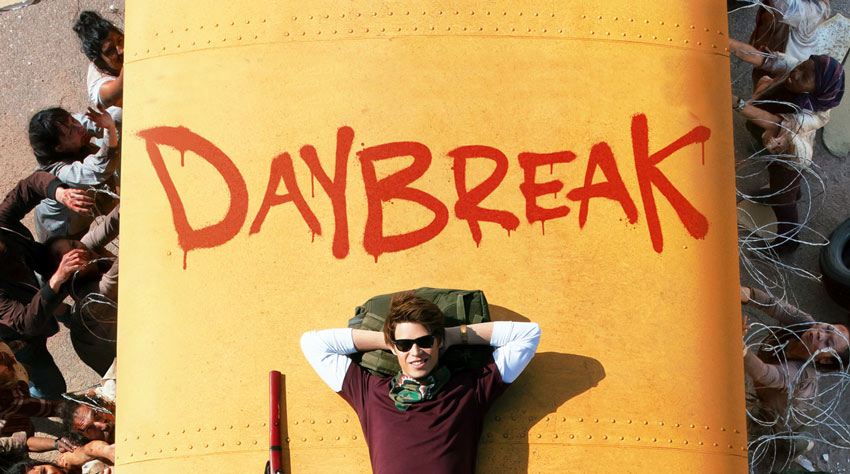
Netflix continues to employ media disruption with its fictional podcast launching this November 7th. The global streaming enterprise is branching out beyond their original series, and concurrently, expanding their own novel programs further with extra content. Daybreak, a new apocalyptic zombie show, launched just a couple of weeks ago as a Netflix original. Now, this podcast will further add to the world the creators have built by depicting a group of teens who make a podcast in the same universe Daybreak takes place in.

This serves a variety of benefits, especially for huge fans. It’s also once again an avant-garde direction no streaming service (at least that I know have) has shot for before. I believe this move, if successful, will motivate Netflix and other streaming services alike to add similar bonus content in other media forms as well. This could possibly be a way for show makers to add more context to their shows which in turn will enrich the original narrative.

This reminds me of the podcast series that spawned from Xbox’s staple series Halo 5. I’m not quite sure of its success, but I know a good number of dedicated fans tuned in for the episodic series that accompanied the video game.

Though, I could see a potential downfall with one company trying to do too much. The reviews aren’t looking super great at the moment for Daybreak, with a 6.8/10 on IMDb. A potential problem would be if Netflix dedicated too much time to try and have both the show and podcast working well concurrently, and ultimately delivering a lackluster product on both ends.

However, I’m optimistic for their future, and Netflix continues to prove its ability to be original in a digital age saturated with derivative content.

Source material: https://www.theverge.com/2019/10/31/20942754/netflix-scripted-the-only-podcast-left-spotify-daybreak-release-date

Roku stock jumps as company adds Apple TV app

roku-logo


Source: https://www.cnbc.com/2019/10/15/roku-stock-jumps-10percent-as-company-adds-apple-tv-app.html

Back in 2018 many tech minds considered Roku one of the biggest TV tech Platforms of our time. Though the streaming device has had a couple of rocky months it has managed to bounce back. Roku was one of the first TV Tech platforms to bring our online streaming services to our televisions.

What made the  Roku service convenient is that consumers only had to buy a device, in an era where subscription services were on the rise. Roku devices come in a variety of sizes, some devices look like a small cable box and others look like a flash drive. The Roku device price ranges from $30 to $100.00.

This week Roku released the news that it would be adding Apple TV + to it’s current streaming channels. This announcement caused Roku’s stock to rise 10%. News such as this build up the anticipation for the long-awaited streaming service. Though we know the release date and some of the new shows being streamed on the platform, there is still an element of mystery surrounding the streaming service. So far we have only heard of 7 shows that will be exclusive  to the platform, but we haven’t heard much about the other releases on the service. Apple TV + will be available on Roku and other streaming devices on November 12, 2019.


Twitter Will Ban All Political Ads, C.E.O. Jack Dorsey Says

Image result for twitter political ads
https://www.nytimes.com/2019/10/30/technology/twitter-political-ads-ban.html

Twitter CEO Jack Dorsey has made an important decision in terms of the social media platform by banning all political advertisements. Dorsey believes the spread of fake news and political advertisements jeopardize democracy. This is in contrast of Facebook CEO Mark Zuckerberg’s stance on the issue, who claims Facebook will continue to receive and promote political ads, regardless of their truthfulness or falsehood.

Dorsey claims political messages should “be earned, not bought”. Responses to this decision have been mixed, while Conservatives are outraged and Democrats are in favor. Trump’s campaign manager claimed it would be a major negative decision for Twitter’s stockholders, which has since been refuted, claiming the lack of political ads will not significantly impact the outlet’s revenue. Democratic Representative Alexandria Ocasio-Cortez concluded that if social media outlets are not going to run basic fact checking on the political ads, they should not be allowed to be posted at all. I agree with this statement, especially considering the widespread misinformation on Facebook for profit and the impact it has on polarizing our country in particular.

Even when Twitter did allow political advertisements, it required verification of the advertisers. The ban will not impede on free speech, which can include toxicity. Another challenge Twitter will experience will be distinguishing what ads will be considered political or not. Twitter’ defines political ads as “advocates for or against legislative issues of national importance,” and this would be including immigration and health care. In my opinion, this will not be entirely detrimental to the spread of information to the masses, but will inhibit the payment for the spread of this information or bias.

I believe Twitter is making an important step on the attack on fake news in this country, and is setting the precedent for other outlets to consider what they can do to stop the spread of misinformation to no longer compromise democracy.

Netflix at 2 times speed?

Image result for fast forwarding

Netflix is the golden standard for streaming content. The relationships they have with their audiences and the actors and talent that works for them, there has never really been a divide. Fast forwarding may be that issue. Netflix has confirmed that they are starting to test out a feature that lets you play content at faster or slower speeds. This feature that has already existed on DVD players for years and more recently sites like Youtube, seems to be drawing a dividing line among creators and audiences. 

Audiences have recently started using the fast forward feature for content like podcasts and videos online but not the streaming giant Netflix. Media creators like Aaron Paul and Judd Apatow have been very direct in opposing adding fast forward controls. Giving those controls to the audience would allow them to alter how we see the content and how the directors and creators wanted us to see the content. Creators take a lot time to put together their work and take great pride in showing their work or story their way. Taking this away by giving controls that let you change the pace cold see many content creators that are Netflix staples move their content elsewhere.

Even with content creators calling for Netflix to scrap this idea, Netflix has confirmed that they are moving forward with testing on mobile devices. This trial period could be more than just testing out new software but also testing out those relationships that could go somewhere else if this feature reaches the global Netflix platform.

Source: https://www.nytimes.com/2019/10/29/style/netflix-speed-playback-video.html

Do we still need Bethesda?

the-outer-worlds-best-ending

Image : https://www.vg247.com/2019/10/28/the-outer-worlds-best-ending/

Video game developer Obsidian has released their latest title, The Outer Worlds and I has been met with acclaim from both critics and fans alike. Obsidian gained notoriety when the worked-on Fallout:  New Vegas, under publisher Bethesda, the owners of the Fallout series.  However, once that game was completed Obsidian turned away from the series and Bethesda in general to strike out on their own. Without Bethesda to back them up many people wondered if Obsidian was capable of retain the game quality fans expected from them. With the recent acclaim their new title is getting it is safe to say that such fears where not founded. Fans were quick to note the similarities between this new game and the fallout games of recent years. Many fans consider Obsidians game to be better than Bethesda, delivering the complexity and feeling of a fallout game the Bethesda has failed to catch with their recent titles. At the same time this comes when Bethesda has continued to foolishly bumble from one mistake to the next. Their latest installment of the Fallout series, fallout 76 was labeled by fans as nothing but a cheap cash grab. This coupled with constant negative press featuring the games features and updates has severely hurt Bethesda’s public image. This begs the question of what lies in the future for Bethesda, as fans that once stood by them leave in order to get the product, they want elsewhere. This also makes said fans question if their original love for the Fallout series is because of the work Bethesda does or despite it.

Article : https://www.forbes.com/sites/paultassi/2019/11/02/outer-worlds-makes-me-want-to-give-all-bethesdas-money-to-obsidian/#5133040a5eae

Will Facebook Ban Political Ads?

facebook-ads

Article: http://nymag.com/intelligencer/2019/10/the-consequences-of-facebook-banning-political-ads.html

Image: https://mediatel.co.uk/newsline/2019/10/28/facebook-and-politics-brexit-ads-dickens-an-apology/

No, Facebook will not ban the ads. With the 2020 election is coming up very quickly and with local elections being on November 5th this year, people are starting to look into candidates. Twitter just said it will be banning political ads from their website because of the type of influence the ads can have on voters. This move got people talking and now people are asking if Facebook will ban political ads too. Brian Feldman from NY Mag quotes Zuckerberg, “it is not the role of Facebook, according to Mark Zuckerberg, to limit the speech of politicians or candidates for political office” (Feldman 2019). Zuckerberg believes that candidates who aren’t well known need his platform to reach people to ensure their voices are heard too. With millions of Americans being on Facebook, politicians have a very easy way to access these people online. They can share and influence and even attack other politicians. It is interesting that Twitter banned ads altogether while Facebook believes that banning the ads hinder free speech.

I found this article interesting because Facebook was a very heavy influence in the 2016 election. One would think to avoid something like that happening again, Zuckerberg would ban the ability for politicians to reach voters through his website. Personally, I would like to see less political ads online because millions and even billions of tax payers’ money are used for these ads. Along with the group that has the most money to pay for advertisements is the person who gets talked about more. Money drives our elections more than anything and politicians with the most money are the ones that run the nation. I find this to be a very bad way to approach voting because the rich politicians are not concerned about what the middle-class and lower-class want, they are concerned with what companies and rich people want. Twitter has been a massive platform for politicians, especially Donald Trump. To see that Twitter won’t allow him to advertise on their site is amazing because this allows people to form their own voting opinions and lessens the ability for fake news and slander to spread. I understand that Zuckerberg will not ban political ads, but I’m curious to see how the future of social media and voting turns out. Will Facebook be forced to ban political ads one day? If they ever do, they will lose a massive amount of earnings, but maybe the issue of fake news on Facebook would diminish for politicians.